Jason Miller gave, unequivocally, one of the best performances in the 1970s as Father Damien Karras in William Friedkin's The Exorcist (1973). Also an accomplished playwright, Miller won both the Pulitzer Prize for Drama and the Tony Award for his play, That Championship Season, in 1973. He was nominated for Best Supporting Actor at the Academy Awards for his role as Karras. Following The Exorcist, Miller starred in Robert Mulligan's truly-underrated and excellent The Nickel Ride (1974). A brilliant actor, capable of generating both emotional intensity and true emotional vulnerability, his subsequent roles in cinema never truly reached the heights of his debut character. Nonetheless, whenever an opportunity to view the actor in a film, it should be seized upon heartily. In 1976, Miller appeared in a Spanish production, El perro, directed by Antonio Isasi-Isasmendi of Summertime Killer (1972) fame. (All objective facts within about Jason Miller are from here and here.)

 Miller is Aristides Ungria, a mathematician and intellectual and political prisoner, in a South American jail. The country is run by a military dictatorship, and Aristides is privy to important information: he holds a mental list of the country's rebel conspirators with whom he is also a participant. Under auspicious circumstances, Aristides and the chain gang are being transported to a work site when their truck gets stuck near the top of a hill. The guard orders all the prisoners to push to free the truck. Aristides is chained to a fellow prisoner who gets his arm wedged under the truck's wheel. The guard pulls a machete and cuts the prisoner's arm off. Aristide is now free and takes the opportunity to dash. He heads into the country's marshland and escapes. A couple of days later, Aristides is found by the prison's tracker and his dog. Miller's character manages to kill the tracker, but with his dying breath, the tracker commands the dog to kill Aristides. The chase begins.
 The set-up for El perro has all of the potential for an at-least interesting action/exploitation film. Subsequent to his escape from the tracker and the dog, Aristides wanders into a rebel camp where he is welcomed and fed. The rebels are met by a helicopter troop of soldiers, and a firefight plays out, ending with the helicopter's explosion. Aristides continues and for the rest of the first act, El perro remains firmly rooted in exploitation territory. Taking the opportunity to bathe in a lagoon, Aristides has his clothes and weaponry on the shore. The dog tracks him down and makes a mad dash into the lagoon to kill. A nude Jason Miller and a ferocious dog engage in a fist-to-paw/claws/jagged-toothed-jaw battle in and out of the lake. Aristides subdues the animal, only to lose his weapons and his clothes. He continues on foot, butt-naked, into the arms of a gorgeous farmer whose husband is away. "How long were you locked up?" she asks. Miller's Aristides looks intensely yet sweetly (in Miller's signature style) and says, "A very long time." She gives him a very good rogering before clothing and feeding him. The dog arrives to attack the farm, only after Miller's character has gratefully been shagged, clothed, and fed. Aristides escapes, again.
The exploitation elements of El perro are strong and familiar and well-rendered by Isasi-Isasmendi who from time to time drops a subjective p.o.v. shot from the dog. With the cross-cutting, it appears from the first act that El perro will play out with two parallel storylines of the film's opponents who meet for battle at intersecting opportunities. Isasi-Isasmendi does not abandon this narrative technique but widely increases the scope of the story. Aristides takes a journey leading him all the way to the country's capital where he reunites with the rebels. As Isai-Isasmendi widens his scope, the story focuses more on drama, and El perro becomes more than an exploitation picture yet still retaining its action roots. Aristide's information is highly valuable to the rebels yet understandingly, he wants to see Muriel (Lea Massari) his long-lost love. She's been put up financially by the government (to keep tabs on her), and in an effective sequence, Aristides and Muriel meet for a risky rendezvous. Miller and Massari are quite good together, as they appear as two lovers who are going to spend their short time together as intensely as possible. Unsurprisingly, the sequence is endearing and a nice touch.
 El perro is in the capital, too, and it takes its own journey. Unsurprisingly, here, this storyline is either far-fetched or truly amazing. It is still a killer and at times, a powerful symbol to both Aristides and the film. This schism in the narrative, and the schism in tone between the three acts may have contributed to El perro's obscurity. All expectations of the film should lead to a simple exploitation film but Isasi-Isasamendi does not stay in that realm exclusively, so the film appears disjointed. If this is a flaw to most viewers, then it is a flaw here and perhaps a glaring one. Miller gives a fantastic performance, because he is Jason Miller. The very handsome, charismatic, and talented Antonio Mayans (aka Robert Foster) appears in a small yet very pivotal role as does the very beautiful, charismatic, and talented Marisa Paredes. El perro is available on DVD as part of the Tales of Voodoo, Vol. 5, under the title "A Dog Called Vengeance." It is a terrible VHS fullscreen transfer.

 Within Sola Ante el Terror, there are two scenes involving (what us yanks call) a baby's stroller. Melissa (
 If you are still reading, then what is the point of the previous paragraph? One, I'm just effing around, and two, the image of an adult Lina Romay in a baby's stroller is perhaps the most unique scene within Sola Ante el Terror. Why? Coming from Jess Franco whose entire filmography is filled with often poetic, jarring, and haunting imagery, the image of Lina Romay in a baby's stroller is unique, because Sola Ante el Terror is completely placid.
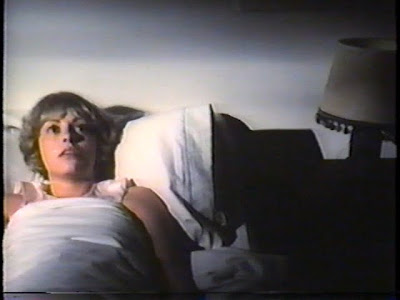 The familiarity of Sola Ante el Terror (within Franco's filmography and employing the auteur theory) lies within Soler's photography, especially the capturing of its location's atmosphere in Alicante. From Melissa's condo, the most breathtaking view comes from her window. A lonely and secluded rock sits slightly off the coast and its cliffs under where the water hits the rocky beach. The communication between grown Melissa and her father is effectively minimal: only the fatal wound of Foster's head is seen in close-up with its dripping red blood to focus upon his mouth and his slow words while his teeth are covered also in blood. The scenes with Melissa and her "doctor," Dr. Orgaf (
 The authors of Obsession write, "Advertising material credits Katja Bjenert [sic], Ann Stern, and Karen Field, but they don't appear in the film." Within Obsession, there is a photo of the Spanish poster corroborating this statement below its writing. Presumably, Bienert would have played the role of Melissa, as she was not yet twenty at the time of Sola's production. Romay was nearly thirty when she performs her role. It would have been a completely different film with a different actress. As the film stands, Romay is, as usually always, quite good. Watching her in childish scenes strains credulity, yet in certain scenes, like when she sits alone on her balcony and watching the young band perform, there is a resonance to her loneliness and sadness. The fact, perhaps, that now she is older (yet still quite young) and has missed the opportunity for teenage love or fun comes through. Also, as she is older, when she is able to walk to exact her father's revenge, it appears liberating for her character and Romay brings a subtle flair to the murder scenes.
  Obscure. Another Franco experiment. All objective facts are taken from essential tome, Obsession: The Films of Jess Franco.
 Candy (
 Save some of the anonymous hooded priests, La Mansion has only seven characters (
 The sexual situations are joking, uninhibited, and come from a liberated culture in Spain. "For Spanish cinema it was a boom," says leading woman, Lina Romay. "There had been a complete opening. From not being able to to show even a breast, we had moved to where almost everything was allowed." (A more detailed discussion of sex in Spanish culture and cinema during this time is included in my review of El Sexo
  Not all is light, however, in
  The best scenes of La Mansion come with the goings on at the convent. The ritualistic acts of violence by the priests are amazingly effective and well-written. Their prayers are as haunting and disturbing as are their acts of violence. The convent and its inhabitants feel ancient and from another world. Franco, during his interview included on the Severin DVD of
  The final act of La Mansion is dark, both literally and thematically. The mystery with Foster's Carlos is revealed as Romay's Candy delves deeper into the area's secrets. The playfulness of the first two acts dissolves and its absence intensifies the third. La Mansion de los Muertos Viventes is a great Franco film: it's another Franco experimental work, seemingly shot spontaneously, yet quite successful in its final result. Robert Foster really stands out and gives one of the best performances that I've seen from him. Franco also deserves a lot of praise for this work here. It was only after the third or fourth time that I had viewed La Mansion that I had realized that Franco had used this location before.


