Patrick (Guy Delorme) and Marianne (Jacqueline Laurent) Mariel, along with their daughter, Linda (Lina Romay), near the threshold of her eighteenth birthday, decide to leave their lush villa and head to the coast for a vacation. Patrick receives a phone call at his holiday destination from a woman named Lorna (Pamela Stanford), who wants Patrick to keep his end of the bargain that the two made nearly eighteen years ago.


 Lorna, The Exorcist (1974) (a more apt title is this French one, Les possédées du diable) is another Robert de Nesle/Jess Franco collaboration. Whatever pact the duo made with the devil of low-budget cinema is unleashed upon the viewer. The trademark Franco production style, cheap, small crew, few actors, single locations, etc., works completely in Lorna's favor. "Franco delays the descent into the plot as long as possible," write the authors of Immoral Tales, "increasing the claustrophobia, working out his compulsions." The film's extremely simplistic narrative allows Franco to paint a perverse tableau of images, shrouded in the most intense and haunting atmosphere.


 The eroticism of Lorna, the Exorcist is carried by Romay's Linda and Stanford's Lorna, and their love scenes are captured by Franco with longing, loving looks, slow embraces, and gentle touching and caressing. Lorna begins with Linda emerging from a balcony to seduce a willing Lorna upon a bed. It's a sequence made all the more powerful upon the later revelation that Lorna is the actual seductress; and Lorna's visits to Linda are in her dreams. Visually this sequence and another where Lorna seduces Linda while taking a bath are treated by Franco at the edges of voyeurism. Each sex scene dares to move one step further into its intimacy, threatening to remove any intimacy at all by revealing all. When Lorna finally confronts Linda and reveals her plans for the young daughter, she tells Linda her tale of first meeting her father and the pact they made before she was born. Lorna and Linda embrace again, and perversely Franco plays on the film's incestuous theme. Apparently, this consummation scene was far more provocative and graphic originally (fact from Immoral Tales) and was absent from my French print of the film. (A still from Lorna from this sequence is included in Obsession: The Films of Jess Franco.) The erotic sequences are not reserved completely for Lorna and Linda. Catherine Lafferière appears as a mad patient (victim or lover of Lorna) being treated by a doctor played by Franco; and her performance is as uninhibited as Romay or Stanford. Her scenes have little narrative weight and seem to exist to only permeate the truly erotic and haunting atmosphere.

 Virtually all of the characters have one motivation and each actor is able to play to his/her motivation with a singular intensity. Delorme's Patrick runs on fear and plays as a desperate man throughout out the film. Laurent's Marianne, like Linda, is a victim of Patrick's pact with Lorna: she doesn't know what to do or what is about to happen. In a particularly nasty scene, she's the victim of one of Lorna's spells in one of the most wince-inducing scenes in Franco's filmography. Lina Romay is fantastic as Linda and is able to genuinely balance the effective and seductive erotic sequences with a wide-eyed performance in the more innocent scenes. Stanford, as Lorna, again delivers with another seductive performance, even all the more brilliant as Franco has her hidden behind quite a bit of bizarre makeup and some impressive costumes. The primary location of the modern hotel lacks the grandeur of the genuine and more ancient locations of Franco's other work, but as the Immoral Tales authors note, the hotel (and Franco's compositions) contributes to the film's claustrophobic and intense atmosphere. Producer Robert de Nesle contributed to the hauntingly beautiful score with André Bénichou, an essential element to Lorna. In Lorna, the Exorcist, Franco plumbs the dark depths and delivers a provocative and dark gem.
Lorna, The Exorcist (1974) (a more apt title is this French one, Les possédées du diable) is another Robert de Nesle/Jess Franco collaboration. Whatever pact the duo made with the devil of low-budget cinema is unleashed upon the viewer. The trademark Franco production style, cheap, small crew, few actors, single locations, etc., works completely in Lorna's favor. "Franco delays the descent into the plot as long as possible," write the authors of Immoral Tales, "increasing the claustrophobia, working out his compulsions." The film's extremely simplistic narrative allows Franco to paint a perverse tableau of images, shrouded in the most intense and haunting atmosphere.The eroticism of Lorna, the Exorcist is carried by Romay's Linda and Stanford's Lorna, and their love scenes are captured by Franco with longing, loving looks, slow embraces, and gentle touching and caressing. Lorna begins with Linda emerging from a balcony to seduce a willing Lorna upon a bed. It's a sequence made all the more powerful upon the later revelation that Lorna is the actual seductress; and Lorna's visits to Linda are in her dreams. Visually this sequence and another where Lorna seduces Linda while taking a bath are treated by Franco at the edges of voyeurism. Each sex scene dares to move one step further into its intimacy, threatening to remove any intimacy at all by revealing all. When Lorna finally confronts Linda and reveals her plans for the young daughter, she tells Linda her tale of first meeting her father and the pact they made before she was born. Lorna and Linda embrace again, and perversely Franco plays on the film's incestuous theme. Apparently, this consummation scene was far more provocative and graphic originally (fact from Immoral Tales) and was absent from my French print of the film. (A still from Lorna from this sequence is included in Obsession: The Films of Jess Franco.) The erotic sequences are not reserved completely for Lorna and Linda. Catherine Lafferière appears as a mad patient (victim or lover of Lorna) being treated by a doctor played by Franco; and her performance is as uninhibited as Romay or Stanford. Her scenes have little narrative weight and seem to exist to only permeate the truly erotic and haunting atmosphere.Virtually all of the characters have one motivation and each actor is able to play to his/her motivation with a singular intensity. Delorme's Patrick runs on fear and plays as a desperate man throughout out the film. Laurent's Marianne, like Linda, is a victim of Patrick's pact with Lorna: she doesn't know what to do or what is about to happen. In a particularly nasty scene, she's the victim of one of Lorna's spells in one of the most wince-inducing scenes in Franco's filmography. Lina Romay is fantastic as Linda and is able to genuinely balance the effective and seductive erotic sequences with a wide-eyed performance in the more innocent scenes. Stanford, as Lorna, again delivers with another seductive performance, even all the more brilliant as Franco has her hidden behind quite a bit of bizarre makeup and some impressive costumes. The primary location of the modern hotel lacks the grandeur of the genuine and more ancient locations of Franco's other work, but as the Immoral Tales authors note, the hotel (and Franco's compositions) contributes to the film's claustrophobic and intense atmosphere. Producer Robert de Nesle contributed to the hauntingly beautiful score with André Bénichou, an essential element to Lorna. In Lorna, the Exorcist, Franco plumbs the dark depths and delivers a provocative and dark gem.

 I've encountered quite a diversity of opinions in my research on Jess Franco's Sinner (1972). The authors of
  Linda (Montserrat Prous) comes from the country to the big city where at a carnival, with her suitcase in hand, she meets an older gentleman who rapes her on the ferris wheel. Linda gets a job with a laundry delivery service and while making her rounds she spies one of her customers, the Countess Anna De Monterey (Anne Libert) having sex with a suitor. The Countess is either curious or taken with young Linda and houses her, eventually having a romantic relationship with her. Eventually, Linda opens up socially and begins a relationship with a man and also with nightclub dancer, Maria (Kali Hansa). Her relationship with Maria causes a rift with her and the Countess, and Linda leaves the Countess's villa. With Maria, Linda gets a fast-track course on both sex and drugs. Linda is eventually arrested and released. A doctor (Howard Vernon) doesn't think Linda is a drug addict and can recover, so he houses her in order to give her treatment. Like all of Linda's relationships within Sinner, it ends badly. The opening sequence of the film is Linda's last day.

 Within Sola Ante el Terror, there are two scenes involving (what us yanks call) a baby's stroller. Melissa (
 If you are still reading, then what is the point of the previous paragraph? One, I'm just effing around, and two, the image of an adult Lina Romay in a baby's stroller is perhaps the most unique scene within Sola Ante el Terror. Why? Coming from Jess Franco whose entire filmography is filled with often poetic, jarring, and haunting imagery, the image of Lina Romay in a baby's stroller is unique, because Sola Ante el Terror is completely placid.
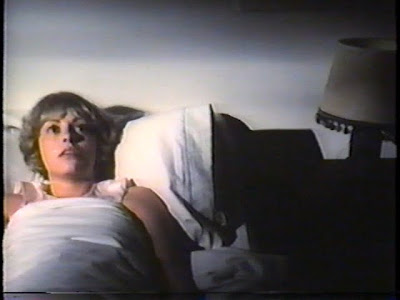 The familiarity of Sola Ante el Terror (within Franco's filmography and employing the auteur theory) lies within Soler's photography, especially the capturing of its location's atmosphere in Alicante. From Melissa's condo, the most breathtaking view comes from her window. A lonely and secluded rock sits slightly off the coast and its cliffs under where the water hits the rocky beach. The communication between grown Melissa and her father is effectively minimal: only the fatal wound of Foster's head is seen in close-up with its dripping red blood to focus upon his mouth and his slow words while his teeth are covered also in blood. The scenes with Melissa and her "doctor," Dr. Orgaf (
 The authors of Obsession write, "Advertising material credits Katja Bjenert [sic], Ann Stern, and Karen Field, but they don't appear in the film." Within Obsession, there is a photo of the Spanish poster corroborating this statement below its writing. Presumably, Bienert would have played the role of Melissa, as she was not yet twenty at the time of Sola's production. Romay was nearly thirty when she performs her role. It would have been a completely different film with a different actress. As the film stands, Romay is, as usually always, quite good. Watching her in childish scenes strains credulity, yet in certain scenes, like when she sits alone on her balcony and watching the young band perform, there is a resonance to her loneliness and sadness. The fact, perhaps, that now she is older (yet still quite young) and has missed the opportunity for teenage love or fun comes through. Also, as she is older, when she is able to walk to exact her father's revenge, it appears liberating for her character and Romay brings a subtle flair to the murder scenes.
  Obscure. Another Franco experiment. All objective facts are taken from essential tome, Obsession: The Films of Jess Franco.
 Candy (
 Save some of the anonymous hooded priests, La Mansion has only seven characters (
 The sexual situations are joking, uninhibited, and come from a liberated culture in Spain. "For Spanish cinema it was a boom," says leading woman, Lina Romay. "There had been a complete opening. From not being able to to show even a breast, we had moved to where almost everything was allowed." (A more detailed discussion of sex in Spanish culture and cinema during this time is included in my review of El Sexo
  Not all is light, however, in
  The best scenes of La Mansion come with the goings on at the convent. The ritualistic acts of violence by the priests are amazingly effective and well-written. Their prayers are as haunting and disturbing as are their acts of violence. The convent and its inhabitants feel ancient and from another world. Franco, during his interview included on the Severin DVD of
  The final act of La Mansion is dark, both literally and thematically. The mystery with Foster's Carlos is revealed as Romay's Candy delves deeper into the area's secrets. The playfulness of the first two acts dissolves and its absence intensifies the third. La Mansion de los Muertos Viventes is a great Franco film: it's another Franco experimental work, seemingly shot spontaneously, yet quite successful in its final result. Robert Foster really stands out and gives one of the best performances that I've seen from him. Franco also deserves a lot of praise for this work here. It was only after the third or fourth time that I had viewed La Mansion that I had realized that Franco had used this location before.


 Johan (