Masuoka (Shinya Tsukamoto) records everything. He doesn't have a steady income and makes his living as a freelance cameraman. He shoots footage and presumably sells it. One day with his video camera, Masuoka is in the subway and captures a man about to commit suicide while the police attempt to talk him out of it. After reviewing his footage at his work desk, Masuoka is convinced that the man killed himself because he was terrified, and what terrified the man was down in the subway in its tunnels and catacombs. Armed with his video camera, Masuoka heads deep down under Tokyo to discover what terrified the man in Marebito (A Stranger from Afar) (2004).
 The director, Takashi Shimizu, is talented. Interestingly (and perhaps ironically) upon its first viewing, the narrative of Marebito is compelling (screenplay by Chiaki Konaka from his novel), and it is easy to surrender to the story and watch it unfold. During a second viewing, it is easier to become detached and watch how the film is constructed. Masuoka doesn't just capture footage with his video camera but he reviews it at the end of the day. At his work deck with multiple monitors and equipment, Masuoka is able to slow, freeze, and replay the events. If Masuoka walked the streets of Tokyo every day and captured the events with only his eyes, then all his critical review would have to come from memory. With his video footage, Masuoka can apply a much more critical eye. During the suicide subway footage, Masuoka is able to capture one frame of a split second, a quick glance by the man down the hallway of the subway. Viewing this one frame during this split second, Masuoka becomes obsessed with what terrified the man and he wants to replicate the experience. Marebito is about the perception and construction of reality. What the eye sees, what the mind perceives and what video captures creates the film.
 Most of the scenes away from directly advancing the narrative seem innocuous. In one telling sequence, Masuoka is walking the streets and holding his camera near his waist. The footage that he is capturing is fuzzier than the primary film footage which Shimizu is using as stock for Marebito. In Shimizu's footage, the faces of street people are blurred, but there is no blurring in Masuoka's footage. A man in a suit walks past Masuoka, and as he turns into a tunnel, Masuoka is confronted by the passing man. Were you recording? he asks. Masuoka lies and says no. The man presses him again and demands the tape in Masuoka's camera. Did you do something bad? asks Masuoka. The man doesn't answer that question, and Shimizu offers no evidence whatsoever for the viewer to speculate upon the question. The blurring/no-blurring footage from Masuoka/Shimizu juxtaposed with Masuoka's encounter with the man (Masuoka gets beaten for his cassette) leads to no discernable, rational answer. Maybe, however, that some people just do not like being captured on camera.
 One of the oddest quirks that Masuoka has is filming his apartment while he is gone. During the course of Marebito, he finds a dweller in the underground and houses her there. Footage is shown of Masuoka purchasing a surveillance camera, designed, as the salesperson describes, to monitor your pets, like a cat, when the homeowner is absent. Masuoka is able to monitor his houseguest from his cellular phone via remote from the camera. However, Shimizu shows his viewer the point of view from the remote camera in Masuoka's apartment before he discovers the dweller in the underground. Why would Masuoka want to film his apartment then, seemingly unoccupied? Perhaps the answer is in the question, as "seemingly unoccupied" is the phrase which hides Masuoka's fear. At the end of a day at his work desk, Masuoka reviews his house footage from the remote camera. He watches his house guest move around and notices in the footage that she is alerted by something/one. The footage blacks out and for twelve seconds, Masuoka has no idea what happened. His house guest is traumatized, and presumably, what caused her distress occurred during the twelve-second blackout. Masuoka is distressed, but the flaw in his plan to capture the world around him is revealed (or the world that he wants to capture/perceive): he cannot completely create his own reality, regardless of his methods.
 Marebito has more layers. Quite a few jokes are made at the media's expense, and Masuoka also has a mental condition, which may or may not be clouding his perception of reality. In any case, Shimizu's sensitive portrait certainly deserves sensitive viewing. Few films like Marebito are so meta yet so organic that for this reason alone, Marebito is worth viewing. With films like the original V-cinema Ju-on, Reincarnation, and this one show that Shimizu's cinema is often top-shelf and extremely provocative.


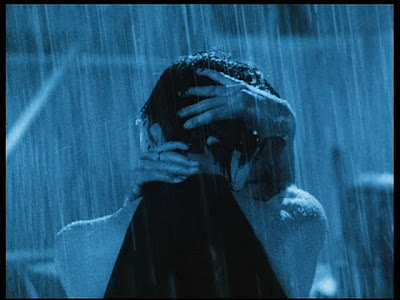 The two above quotes are from Shinya Tsukamoto in reference to his 2002 film, A Snake of June. If his film were nothing but images evoked from within his first quote, then Snake would still be devastating. If it were only a film of two sequences--of Rinko, portrayed by Asuka Kurosawa, taking two public walks, each in her miniskirt, both charged with two radically different emotions, then Snake would still tell its story. Finally, if the film were nothing but a series of animated still images, with their style monochromatic and shot in 1:1.33 aspect ratio, where Tsukamoto found inspiration in Robert Mapplethorpe, Helmut Newton, and Bruce Weber, then Tsukamoto's rendition of images would still surpass many of his contemporaries working in the visual medium.
 Rinko works at a crisis center as a telephone counselor and receives anonymous calls from the public of tales of suicide and the like. She lives in quiet comfort with her salaryman husband, Shigehiko (Yuji Kohtari), who is often distant from Rinko and prefers to be alone reading or scrubbing the sink or the bathtub. Despite the lack of emotional intimacy in their relationship, each shares a comfort in its predictability and normalcy. One day Rinko receives in the mail an envelope containing a series of still photographs of her in repose or walking the streets; and as she flips through the numerous photographs (to be noted, not incidentally, artistically and professionally captured), the final series at the end of the stack reveals Rinko in quite an intimate moment and alone. Rinko feels understandably violated by this intrusion and overcome with fear of the photographer. When a cellular phone arrives via mail and its caller, a familiar voice to Rinko from her crisis center work, demands that Rinko reproduce her behavior evoked from the still photographic images, Rinko consents--seemingly only in exchange to receive the original negatives to the photos and to hopefully hide them away, not just from her husband but from the world.
 A Snake of June makes the heart beat fast: fear, excitement, and eroticism. The film's closest and most sensitive portrayal is in Rinko, not just with the camera's treatment but with her emotion. As she reluctantly begins her first display for the caller, who commands her from time to time to change her outfit, walk in a particular area, or perform some task, the fear and discomfort which radiates from Rinko is overwhelming. The caller attempts to coax Rinko into revealing her true sexual desires, as if the caller, by capturing Rinko alone and in an intimate moment, now possesses knowledge of her secrets. What the caller painfully and powerfully fails to recognize is those secrets and desires belong Rinko alone. The irony, of course, is what the caller desires most from Rinko, she later displays willingly and perhaps not solely for him. When Rinko uncoils, so to speak, the desire to do so does not come from the pitiful voice on the phone. Any excitement comes for the viewer at Rinko's expense and it's uncomfortable watching Rinko the subject to many a prying eye. Kurosawa gives a stellar performance, completely vulnerable, as Rinko.
 One of Tsukamoto's favorite motifs is the triangle, and the characters behind the caller and Kohtari's Shigehiko are revealed, in true Tsukamoto fashion, as not vehicles but well-drawn people. Their characters become the most revelatory during Rinko's second display in A Snake of June, which by this point is in Tsukamoto's world, opened, perhaps by a Pandora-ish Rinko.
 The bluish tint to the monochromatic images within A Snake of June are unique coming from a unique film maker. Tsukamoto is wholly successful in creating animated images which are evocative of his still-photographic inspiration. Most of the settings are clean and clinical, like the crisis center, Rinko and Shigehiko's home, and the myriad public places where Rinko walks. These are wonderfully and powerfully offset by Tsukamoto's subjective and artistic shots with especially the use of water in the scenery. The compositions are fantastic, and as always, Tsukamoto tells two stories always, one with his visuals and another with his narrative. A Snake of June is a strong mix of naturalistic scenes, scenes of man-made structures, and the beautifully imagined sequences where Tsukamoto journeys into dreamland. The atmosphere which Tsukamoto feels when "it gets humid and hot in Japan" is, finally, also successfully translated to his film.
 As for Kagenuma's character and background, it is shrouded in mystery in Akumu Tantei. As for the plot of Akumu Tantei, Tsukamoto crafts a mystery, a thriller involving a killer who is murdering others who are on the brink of suicide. The police encounter two deaths, one of a twenty-year old woman and the other, a married salaryman with a fondness for junk food. Both deaths appear to be suicides: case closed. However, the link between the two deaths is a phone number on both victims' cell phones, noted only as the number "0." Believing that it is prudent to investigate this odd and suspicious link between the two victims, the police plan on calling the number to identify the holder of the "0" phone number. Maybe the two deaths were not suicides at all and perhaps the voice on the phone induced his victims into killing themselves. Or maybe something sicker and more sinister is occurring. Keiko (hitomi) has just become a police detective and the caller "0" case is her first. Keiko is put in charge of investigating whether dreams had anything to do with the killings and she is led to an encounter with Kagenuma.
 For a film maker who possesses a unique and powerful imagination, Akumu Tantei, at first blush, appears traditional and conventional, coming from a director whose previous works could rarely be labeled as such. This observation would be mostly correct. However, upon closer inspection (and perhaps subsequent viewings), this observation is proved wholly false as Akumu Tantei is much deeper and richer than its surface narrative would have its viewer believe. The film's creativity lies within its characters, primarily three, caller "0," Keiko, and of course, Kagenuma. As these three are drawn together in Tsukamoto's web, the complexity to their characters is revealed as the narrative mystery is also seamlessly revealed. The modus operandi of caller "0" is slick and creatively rendered: one who allegedly murders his victims on the brink of suicide. The interesting question is why: murder as an action, in these circumstances, would be redundant. Tsukamoto's imagination provides a very compelling and offbeat answer to this question. Keiko is not a typical newbie to the police force: she's not a rookie out of the academy, bright-eyed and green; but rather, Keiko has sought a demotion to detective from an elite position within the government's ministry. Again the most compelling question is why: what drives hitomi's Keiko to leave a prestigious job, with presumably more comfort, to engage in police investigation where the hours are long, the cases intense and bloody, and the prestige is almost non-existent. "You might not want to wear high heels," a colleague tells Keiko during her first crime scene investigation. "You might have to run." "Is that an order?" asks Keiko, not even looking at her colleague as she strolls up the stairs.
 The titular character of the film with a somewhat deceiving English-language title, Kagenuma, has the most mystery and is a completely torn character, reluctantly drawn into the action by the film's narrative. (A viewing of Akumu Tantei's sequel, Akumu Tantei 2 (2009), also directed by Tsukamoto, goes much deeper into his character. The two films richly play to each other, and the sequel seriously informs a viewing of the original. However, discussion of the sequel is for another day.) Tsukamoto does not give any exposition or overt background to his character: everything about Kagenuma is revealed through his character's interactions or through Tsukamoto's compositions. Both are very well done. The opening of the film is very creative and Kagenuma's appearance is effective. To describe it would be to ruin it, as the opening is so subtly crafted. Keiko's first meeting with Kagenuma is memorable: watching how Tsukamoto blocks his characters and frames them speaks louder than the characters' dialogue. Within the final act of Akumu Tantei, Tsukamoto blends both the imagery and what is hidden in his three primary characters powerfully.
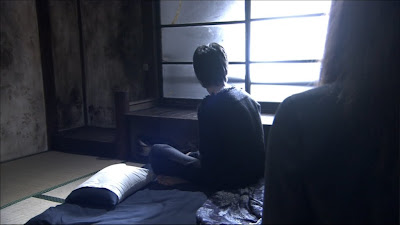 Visually, Akumu Tantei prefers the dark, and the "nightmare" alluded to in the English-language title is appropriate. Whenever Tsukamoto has the opportunity to paint his characters in the dark, he does. To say that light is used judiciously is an understatement and when light is used, it is effective. Some familiar and signature Tsukamoto visuals are present, such as the p.o.v. shot flying down corridors or alleys and shaking accompanying camerawork. When Tsukamoto's films take a turn into dreamland, the mise-en-scene rapidly changes: the odd close-up on something innocuous, the hyper-odd special effect or gore scene coming totally unexpected, and cross-cuts from the present into somewhere else, either the past or a time that doesn't exist. With Akumu Tantei, Tsukamoto delivers again with his visuals.
 Gorgeous