A young man (Gérard Blain), while his sister (Jeanne Valérie) does not watch from behind a fire, beats upon another member of the underworld. With a cinematic "message" killing, the beaten member is set afire in front of an appropriate locale, and Blain and his crew shoot up the establishment. The death of the man is relayed by telephone to the boss as he is awakened in bed with his lady. In the frame, the boss occupies a judicious space in the right corner--enough to show his talking head and the telephone--while his lady slowly dresses in her undergarments and outfit (dominating really the entire frame). A quick scene of comforting then leads to a funeral procession in which Blain makes an appearance--with machine-gun fire, he shoots at several of the cars in the procession and speeds off. No return fire. Beautiful pastoral scenery follows as the mourners exit their bullet-ridden vehicles to quietly bury their member in the cemetery. Now at the club, Blain is having a drink; and a striptease begins. Neither the director, José Bénazéraf, nor his actresses are shy--powerful female sexuality, lovingly captured, ensues. "Absolutely. Absolutely." Bénazéraf answers in response to the question, "Do you think the banning of Joë Caligula was the revenge of the authorities for your earlier defiance?" Bénazéraf continues, "It was revenge. Because of my opposition to all that administration and bureaucracy. So they fucked me and they fucked me well." (from Immoral Tales: European Sex and Horror Movies 1956-1984 by Cathal Tohill & Pete Tombs, St. Martin's Griffin Press, New York, 1995, p. 217.)

 "It's a very sad story. I made the film with Gérard Blain, who was quite a star of the nouvelle vague. It was a story of incest--but intellectual incest--between a man and his sister. I made it in a kind of--in France we say 'extase'--because I believed totally in that movie. I took it very seriously. I invested a lot of money. I shot in in black and white. It was Bonnie and Clyde--the same kind of mood, the same kind of tenderness and the same kind of violence. It was Bonnie and Clyde--but two years earlier. I showed it to the censors and they said over 18 only. So I said, OK, over 18 only. I had national release and on Wednesday, the day before release, we had 30 or 40 copies across France and they said, 'No. Completely banned.' And I was left with 30 prints of the film and all the costs to pay. And I couldn't export the film or exploit it. And it's so sad because perhaps it's the best movie I ever made. The only really good one. They said I was making an apology for violence. You know--the old routine. Gratuitous violence." (Immoral Tales, pp. 216-17.)
"Absolutely. Absolutely." Bénazéraf answers in response to the question, "Do you think the banning of Joë Caligula was the revenge of the authorities for your earlier defiance?" Bénazéraf continues, "It was revenge. Because of my opposition to all that administration and bureaucracy. So they fucked me and they fucked me well." (from Immoral Tales: European Sex and Horror Movies 1956-1984 by Cathal Tohill & Pete Tombs, St. Martin's Griffin Press, New York, 1995, p. 217.) "It's a very sad story. I made the film with Gérard Blain, who was quite a star of the nouvelle vague. It was a story of incest--but intellectual incest--between a man and his sister. I made it in a kind of--in France we say 'extase'--because I believed totally in that movie. I took it very seriously. I invested a lot of money. I shot in in black and white. It was Bonnie and Clyde--the same kind of mood, the same kind of tenderness and the same kind of violence. It was Bonnie and Clyde--but two years earlier. I showed it to the censors and they said over 18 only. So I said, OK, over 18 only. I had national release and on Wednesday, the day before release, we had 30 or 40 copies across France and they said, 'No. Completely banned.' And I was left with 30 prints of the film and all the costs to pay. And I couldn't export the film or exploit it. And it's so sad because perhaps it's the best movie I ever made. The only really good one. They said I was making an apology for violence. You know--the old routine. Gratuitous violence." (Immoral Tales, pp. 216-17.)
 Joë Caligula shifts in its imagery from often sexual or violent to a scene of still life whether it's characters in repose or a setting of street life or the occasional scene in the country. However, there is no overt tonal shift in the imagery. When Gérard Blain puts on his sunglasses, a quirky and raucous tune begins, like an audio cue to accompany the sunglasses--here comes cool gangster persona...now here comes me pulling my gun...check this out, it's me committing a crime. There's an energy to Blain's rampages and violence but it fades as the film continues. Most enthusiasm is shown by Bénazéraf when he captures his actresses' imagery. Overall their imagery overwhelms the violent scenes as there is more poeticism watching Jeanne Valérie take a solitary stroll at night on the streets of Paris or watching Blain and crew hanging out at the cafe with their female company.


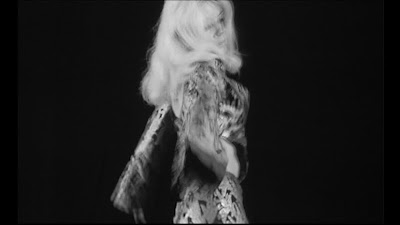 Blain's Joë Caligula is a rebellious character in a overt nod against the old guard. Ironically, his character and his narrative arc can only channel a modicum of Bénazéraf's cinematic rebellion and willfulness. In the majority of Bénazéraf's cinema that I have seen, there is an overwhelming sense of a filmmaker filming what he wants to. And obviously was pissing a few people off. There is a scene near the end of the film with Blain all alone sitting at a table, a wide shot emphasizing his solitude. Perhaps, this is the most affecting scene within Joë Caligula.


 Nora spends her captive time in Eric's maison being tended at bedside by Vanda (Regine Rumen) who doesn't particularly care for Nora's presence. They have little to say to each other, and little to do. Vanda brings her a cup of tea or pours a bowl of soup on her, and the two have a fight. Bénazéraf wants to capture these two actresses, however, with his camera. (Rumen apparently was a famous dancer at the time in Paris. I found a few pieces of evidence corroborating this with the strongest piece

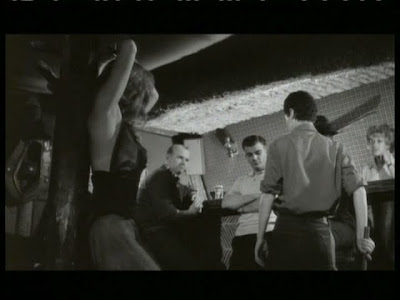
 "So I started to direct movies as a 'boutade'--you know what that is?" asks Bénazéraf to an interviewer. "A whim?" responds the interviewer. "Yes, OK. So I started making movies as a whim. I liked pretty girls--which is a male reaction, but completely simple and elementary. So I started making movies with pretty girls in them. And, making movies with pretty girls, I found I put some erotic scenes in because it was quite...exciting, let's use the word. But every step of it was completely by accident." (from Immoral Tales: European Sex and Horror Movies 1956-1984 by Cathal Tohill and Pete Tombs, St. Martin's Griffin Press, New York, 1995.) Eric's second, played by Michel Lemoine, visits a nightclub later in Le concerto to rendezvous with a contact. Not surprisingly, neither Lemoine nor his contact are focal in any composition. Rather the lady dancers are focal in the scene. It is a blatant opportunity for Bénazéraf to capture some images.

 The American version of Le concerto de la peur was released as Night of Lust. "[Dick Randall] was representing a guy in Los Angeles who was more or less a gangster (Bob Cresse). He wanted to buy a little film of mine called Concerto de la peur. To me it was new selling to the Americans. Be he paid me cash--10 or 15 thousand dollars. Not a lot of money but it was only a couple of weeks shooting. I made my films quickly even in those days. I asked him if he wanted a contract and he said, 'No--why bother?' He had a big success with that film in the States. It was called Night of Lust over there." (from Immoral Tales: European Sex and Horror Movies 1956-1984 by Cathal Tohill and Pete Tombs, St. Martin's Griffin Press, New York, 1995.) According to Immoral Tales's authors, Cresse recut the film with R. Lee Frost shooting new footage. Night of Lust runs about twelve to fifteen minutes shorter than Le concerto with little dubbing of the French audio. The majority of the scenes have English voice-over narration describing the action with the occasional commentary. Cresse and company were going for the expose of the seedier side of Paris. The new footage is primarily every opportunity to provide a striptease, and Bénazéraf's loose narrative fueled the scenarios. Two very different films: one quiet, the other not.


 "Une bande de petits truands y sequestre la nana dans une maison isolee, esperant la rancon prevue pour le lendemain matin, L'angoisse de l'attente de l'aube, l'insondable profondeur de la nuit, son silence, exasperent la tension grandissante, trouvant ici encore son aboutissement dans un denouement dramatique. Jose Benazeraf y est lui-meme spectateur d'une tres excitante danse sapho-masochiste de deux creatures denudees, l'une feminine et se caressant elle-meme, l'autre hermaphrodite, la dominant, jouant avec elle, et la soumettant a son fouet." (from Anthologie Permanente de l'Erotisme au Cinema José Bénazéraf by Paul Herve Mathis and Anna Angel, ed. Eric Losfeld, Le Terrain Vague, Paris, France, 1973)
 As soon as the group's victim, Virginie (Virginie Solenn), arrives at the house, she lashes out upon one, Carl (Yves Duffaut), by raking her nails down his cheeks. He hits her and knocks her out, and Pierre (Alain Tissier) takes her upstairs to the bedroom. Pierre descends the stairs, looking tired or either bored, sits at the table and Carl has a bit of fun by pointing a pistol at his face. Pierre turns to the sound of music and watches the boss's mistress (Annie Josse) dancing in the corner, seemingly uncaring and unaware as to what is going on around her.

 Bénazéraf's
 Perhaps the sexiest thing about
 "For...L'enfer sur la plage (Hell on the Beach; 1965), Benazeraf returned to the B-thriller style of L'eternite...Both films were successful, and both featured the expected Benazeraf mix of action, pretty girls and bare flesh that had already become his trade mark. But another, slightly more worrying, trait was also in evidence. As Cahiers du cinema noted, it was impossible to make any sense of the stories. Daylight shots appeared in the middle of sequences filmed at night; the dialogue often seemed unrelated to the action; establishing shots were done away with; long scenes filmed in single take replaced any conventional montage. The wilfulness that had always been present now took centre stage. But still there was a power and presence there and a determination to film, come what may. Even without a story, without dialogue and with no idea of where he was going Benazeraf loaded his camera and began to shoot. 'With all the stubborness and dignity of an angler in the middle of the desert.'

 Bazookas. Bikinis. The beach. Beautiful women. A score by Louiguy and legendary
 The MI5 makes an appearance, yet amongst all their intelligence-gathering computer technology, making typing noise and buzzing and whirring, Bénazéraf prefers the slow quiet shot of a female agent descending the stairs and walking in between the machines to gather a bit of paper. More specifically, it is the agent’s legs which capture Bénazéraf's eye on the stairwell, and as his camera stays static, the actress’s beautiful face comes into focus with a mischievous smile upon her face. Frogmen board the boat for a fight, while the well-dressed dinner guests watch emotionless as the deckhands dispatch the would-be assassins. A long shot of a female walking the shoreline of a beach at night follows, strolling to the soft tunes of the piano score. A phone call in the city and then back to the beach where two lovers descend the rocks to embrace at the bottom.

 Such a beautiful careless attitude carries L'enfer sur la plage. Bénazéraf loves to show ladies dancing, often slowly and seductively. These aren’t voyeuristic sequences: it’s open: the dancers are willing performers for willing viewers. The young blonde in the bikini eventually boards the boat where the dinner guests staved off two attacks; yet she’s the most successful in infiltrating those aboard. She dances at the side of the dinner table for the host, while the other two lovers take sanctuary at the shore. Atop the deck, the young blonde puts her hooks firmly into the host while casually rocking in a hammock. Chet Baker’s trumpet accompanies her swings. Some more espionage, back-stabbing, and a shoot out end the film. This is sex and violence, French-cinema-sixties style. God bless Bénazéraf.

 "They called you the Antonioni of Pigalle," remarks an interviewer in Immoral Tales, to which Bénazéraf responds, "That's right."