Start-up capital and small business. An economics classroom and a business file. The Butcher. The Doctor. The Boar. Brain. The Cop. Comic books. Fast food. The sign of the cross three times. Vinyl records. The early-90s in Russia in the provinces.
 Zhmurki (Dead Man's Bluff) is a film directed by Alexsey Balabanov and released in 2005. Sergei (Aleksei Panin) and Simon (Dmitriy Dyuzhev) work for Mikhajlovich (Nikita Mikhalkov), the local crime boss, and are effing up their first two jobs of the morning--one, collecting money from The Doctor; and two, delivering a case to a lawyer and picking up a case in return. Mikhajlovich, after their two eff-ups, gives the pair one more chance to perform a successful task for him--clean up the mess created by their two previous eff-ups. Time to visit The Cop.
 Balabanov's Dead Man's Bluff chooses as its setting recent history in Russia which, undoubtedly, speaks more to its culture. It is unknown as to whether Balabanov wants to transcend his culture with his story and his visual depiction of his story. Like a joke, the more familiar the listener is with the joke's set-up and details, then the potential for the punchline to be funnier is greatly increased. However, scenes like the initial one, set in 2005 in a university classroom where an economics lecture is given, give Dead Man's Bluff the feeling that perhaps the film is intended for a wider audience, like giving a set-up to a set-up to a joke for unfamiliar viewers. Despite any familiarity with the history of the setting or the setting and its culture, Balabanov's Dead Man's Bluff plays out like a playful joke, fluctuating in seriousness and disturbing, like giving a hearty laugh and then giving an uncomfortable sigh upon reflection at the joke's subject matter. Comedy is extremely difficult to craft but highly successful and entertaining when done well. More challenging is to infuse comedy with dark and disturbing material, and when that comedy is successful, the result is Dead Man's Bluff.
 Set in a world of small business whose business is crime, The Butcher stands over his bound captive with his syringe in hand and myriad dead corpses littered around his shop. Balabanov's composition (like most within Dead Man's Bluff, it is static and meticulously-framed) is far too disturbing to induce a chuckle alone, so he allows The Butcher to pontificate on his impressive attributes and abilities. It's unsurprising that he is so successful. Three hooded gunmen make a surprise entrance and contribute to the corpses. How about The Doctor? Balabanov's composition of The Doctor is far too ridiculous, looking like a mad scientist behind his Bunsen burner and beakers, to be taken seriously. Sergei and Simon try shaking him down for protection money, but The Doctor doesn't need to pay outsiders for protection: he has two hulking bodyguards on his payroll, and they make a fortuitous entrance into The Doctor's laboratory. Corpses and their blood end up spilling everywhere. The Boar has a driver in a slick Mercedes and has become successful in the Center. The Boar hands his business card to Sergei in front of the McDonald's restaurant where inside Simon purchases an extra-value meal for seventy-three thousand roubles.
 From its opening, Dead Man's Bluff presents the early days of the generation of start-up capital for future business entrepreneurs, where the overhead are corpses and the collateral is violence. Beyond the very cleverly rendered humor, like the business file that Sergei carries everywhere, Balabanov portrays his brutal violence in a business-like manner: the victims will cry for help and scream, but their executioners are without emotion, like workers suffering from the banality of routine. Balabanov embraces his executioners' (lack of) emotion and tone with his visual style. If his killers have no qualms with the amount of blood that they are shedding and corpses literally piling up, then neither does Balabanov. This seeming detachment from its director makes Dead Man's Bluff, like the game referenced in its English-language title, kind of dangerous. Often viewers, like joke listeners, want to be on the inside as to what is going on. Being on the outside of a joke or a movie, often the listener or viewer, respectively, feels as if the joke is on him/her or at his/her expense. With often static compositions and sombre colors, Balabanov frames his images like still-life paintings with its subject matter far from the familiar. The humor pulls the viewer in closer to the action while its disturbing matter attempts to push the viewer back out.
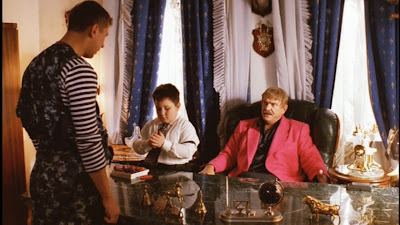 Zhmurki (Dead Man's Bluff) is fun. Balabanov appears in his position to feel totally comfortable being under no obligation to tell his viewer how to feel. This is true court-jester cinema: being playful and creative, making the jokes at every one's expense, including his own, while his subject matter is undoubtedly important and relevant. All the performances are tops. Truly unique.


 Cargo 200 begins with brothers, Misha, an army colonel, and Artyom, a professor of scientific atheism at a university, eating dinner and talking on the balcony of Misha's flat. "Imagine," says Misha, "what is happening to the rest of the country." Misha is speaking of his current job: Cargo 200, twenty-six coffins, arriving from Afghanistan, housing Russian soldiers. Misha locates the relatives, delivers his heartfelt condolences, and makes arrangements to bury the coffins. His daughter Liza arrives with her fiance, Valera, and the two say hello, before having some tea. Valera and Liza have to get up early the next day for a trip, but Valera says he's got to go out for a bit. Valera is going to a disco and getting effed up, unbeknownst to Liza, and will be sharing the same road to Leninsk as Artyom, who is going to see his mother. Artyom's car breaks down on the road to Leninsk, and unable to flag anyone down, he walks to a farmhouse, where a sinister-looking older man stands at the gate. The sinister-looking older man says nothing to Artyom about help and cocks his thumb towards the farmhouse behind him. Inside the farmhouse, Artyom encounters a soldier, indicated by his blue-and-white shirt, cleaning a shotgun. He welcomes Artyom in for some dinner and vodka. Meanwhile, Valera is at the disco, getting drunk and running into Liza's girlfriend, Angelica. As the night wears on, the soldier, Alexi, his gardener, Sunya (a Russian corruption of his Vietnamese name), Arytom, and Valera, all become inebriated. Three remain sober: Angelica, who has left the dance with Valera to go to the farmhouse to get booze, Tonya, who can barely hide her contempt while cooking for the drunk men at the farmhouse, and the sinister-looking older man lingering outside of the farmhouse.


 The remainder of what follows in Cargo 200 should remain hidden but needless to say, the remainder is extremely charged, artistic, and often cruel. Cargo 200 is a non-nostalgic look at recent history in Russia, and I can say now, if it wasn't apparent before, Alexsey Balabanov is one of contemporary cinema's finest film makers. His film Brother (1997), starring Sergei Bodrov Jr., is an amazingly intense and bleak crime picture, fuelled by recent events and a very adept eye behind the camera. Balabanov would follow Brother with his surreal Of Freaks and Men (1998). Balabanov's take on America comes in Brother 2 (2000) with the seriously-intense War (2002) following. In a one-hundred-and-eighty-degree turn from Brother, Balabanov would get extremely playful and often nasty with his crime flick, Blind Man's Bluff (2005), only then to violently change direction again with the sentimental and affecting (and nostalgic) It Doesn't Hurt (2006). Balabanov's visual style is the very definition of unassuming and his compositions feel so organic. Perhaps a lack or minimal use of dramatic music or the use of such soft colors lull the viewer into complacency, which is often violently disrupted with powerful images of emotion, commotion, or violence. Cargo 200 shares his unique and compelling style and regardless of what happened on screen, I remained glued. There are some sequences within Cargo 200 which are unbelievably too fantastically surreal to be true or real. However, when I view the sequences, I am never full of doubt, as if I've been looped through the extreme back into normalcy...if that makes any sense. While Russian viewers I am certain will get more of the intimate history, viewers from all regions will be affected by Balabanov's art. Balabanov is a film maker that I will continue to follow, wherever his art will take him.