Irem (Al Cliver) and Barbara (Silvia Dionisio) are a good-looking young couple, who, at Cefalù, spy another couple, Giorgio (John Steiner) and Silvia (Elizabeth Turner), water skiing. Giorgio knocks Silvia from her tether, and while she is splashing in the water, Giorgio makes an intentional turn towards her head, almost killing her. Witnessing this cruel display by Giorgio, Barbara and Irem decide to interject themselves into the lives of Giorgio and Silvia and play a game. Barbara quickly seduces Giorgio with her beauty; and eventually, Giorgio invites both Barbara and Irem to accompany himself and Silvia aboard his yacht for a weekend cruise. Soon after boarding the yacht, Barbara and Irem quickly learn that Giorgio and Silvia like to play games, too.  Una ondata di piacere (1975) marks a return to cinema after an absence of years for its director, Ruggero Deodato. In his own words, Deodato speaks of its genesis, taken from his interview included as a part of a featurette of the Raro DVD release:
Una ondata di piacere (1975) marks a return to cinema after an absence of years for its director, Ruggero Deodato. In his own words, Deodato speaks of its genesis, taken from his interview included as a part of a featurette of the Raro DVD release: "Waves of Lust" is a film that I didn't really want to do at first. I'd been in the doldrums. I'd shot some comedies but then I was prohibited from making anymore because of competition and various other reasons. In the meantime I'd married a girl [Silvia Dionisio] who started out with me and got very famous. That's why I wanted to distance myself from cinema. The woman's always more important than the man. If I'd made five films in a year, the woman would get more famous by doing just one. And the husband is seen as being past it. I didn't like the idea of that so I started working in advertising. I was very successful but it always felt really sad when I went to Milan and saw a crew arrive from Rome to shoot a film. I'd get depressed.
They'd always call me with an ulterior motive. "Can you bring your wife as well?" My wife was already working with Monicelli and Scola, why should she make B movies with me? Agents in the business would ask me to go and see them and tell me to take my wife too. But she already had an agent. That's why I distanced myself. Then I got the offer to this film, and even though I wasn't keen on the erotic aspect of the story I thought I could steer it into thriller territory and manage to maneuver it out of the erotic ghetto. But I got ripped off, because my wife said: "You not doing this film if I'm not in it." But she couldn't do it, because the female lead was already cast. She said: "You're not making a film with a naked woman if that woman isn't me. As soon as all my other colleagues start to strip off, like Ornella Muti, I want to be able to say I did it with my husband." I told her it was impossible, but she was so persuasive with me and the producers that they annulled the contract with the other actress and my wife did it for a quarter of her normal fee. So for me it was quite a difficult shoot, because not only did I have to get my wife naked, but I had to make sure she came out looking good. It's difficult to direct your wife when she's naked, making her adopt certain positions. She'd say: "Wasn't that okay?" It was more than okay...but it was a very embarrassing shoot. It was even more embarrassing because the film was a huge success. It made a fortune. But my wife lost a contract because of it. Actually it was a contract we both had with a production company to advertise a famous liquor. The owner said: "After this film I don't want either of you."
 In Cannibal Holocaust and The Savage Cinema of Ruggero Deodato, Deodato relates this version of the film's genesis:
 The producers Marras and Salviani, offered me the chance to make an erotic film; this style of movie was in fashion at the time. Muti, Giorgi, and Agnostina Belli were the pioneers and then everyone started doing it. I had planned to shoot that film with another actress, who at the last minute refused to be film naked. So I put forward my wife's name to the producers; at that time she was a star and had never got undressed before the cameras. She accepted the part only because her peers were doing this sort of film at the time. (p. 14, FAB Press, Surrey, U.K., edited by Harvey Fenton, 1999.)
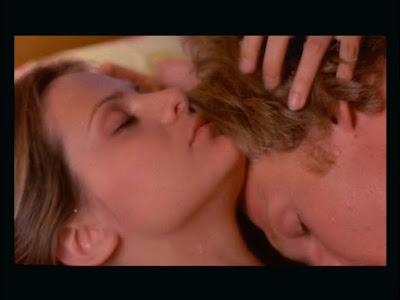 Una ondata di piacere benefits from its tight and almost primary setting, Giorgio’s yacht, four characters, with each actor giving an effective performance, and a willingness to be provocative, leaving the conservative perhaps back at shore. It is a film about power and its perversity, its ridiculousness, and its attraction.
  John Steiner’s Giorgio is the most overt character with the most stereotypical rendition of power. Giorgio’s wealthy, competitive, and possessive; and perhaps as a result of these traits, he is cruel. He enjoys berating and abusing his wife, Silvia. Giorgio refuses a business deal with a down-on-his-luck colleague, and it is intimated in a later scene that this colleague committed suicide because of this refusal. Giorgio could have helped, exclaims Silvia, but he didn’t want to, intimating that Giorgio took some pleasure in rebuffing his colleague. In another sequence on the yacht, Irem overhears Giorgio tells his lawyer via phone to close a deal with its end result being the unemployment of six hundred workers. Giorgio doesn’t care in the least, and this irks Irem. Dionisio’s Barbara immediately realizes Giorgio’s nature, and as the film progresses, it becomes clear that Barbara’s plan is to seduce Giorgio. However, she is never going to complete the seduction: the ultimate punishment is to deny Giorgio what he wants the most. For someone so driven and possessive and cruel like Giorgio, to be denied anything could kill him. Barbara’s plan does not work as conceived.
  The perversity of Una ondata di piacere reveals itself during the second act. Elizabeth Turner’s Silvia reveals herself as not a victim but as very complacent in her position. In their cabin, Barbara and Irem stare incredulously as they hear Giorgio and Silvia have sex in their cabin. Barbara remarks, humorously, from the noises that they are making now, one would never think that they tried to kill each other earlier that day. Irem remarks that they seem like a master and happy slave. Barbara still attempts to exact her plan but she is never able to make any effective headway. Meanwhile, Irem develops a blossoming obsession towards Silvia. Like Barbara, Silvia seems to enjoy seducing Irem yet keeping him effectively at bay. Silvia’s character takes a perverse turn, as does Barbara‘s--when the third act begins, Barbara changes her plan, and when the credits roll, the viewer will certainly be questioning her cruelty.
  Ruggero Deodato has always been a court jester of cinema, enjoying being willful and provocative for the sake of being so. I admire this tremendously. The thriller plot of Una ondata di piacere is tired; and the real interest of the film is in watching these characters reveal their different layers with totally unexpected results. In fact, as much as Una ondata di piacere is touted as an erotic film, Deodato shoots the film as if it weren’t: the film has an organic style, none of the nudity or the sex is particularly treated with flourish. When Turner and Dionisio disrobe in front of each other, Deodato’s composition doesn’t change. Like a conversation, the inclusion of any skin into the frame just continues. When Irem attempts to fuck Silvia, Deodato shoots them on the small staircase leading from the cabin to the upper deck. There’s nothing special about the setting nor the atmosphere: there’s only Irem’s obsession and Silvia’s seduction. Any eroticism from the film is generated from the actors: gorgeous Dionisio is as seductive in her jeans and hooded sweatshirt walking the streets of Cefalù as she is sunbathing topless on the deck of the yacht. Deodato’s primary composition of Dionisio is a facial close-up. Cliver and Turner generate heat in their few sequences, and Steiner, perhaps intentionally with his performance, looks buffoonish in his sexual scenes.

 Una ondata di piacere is unexpected in Deodato style and is worth seeing if not just for Silvia Dionisio’s precious performance. She captures every frame and is the very definition of charismatic. While Steiner’s character is the most overt and Turner’s character the most subverted, Dionisio’s character is the most unexpected and holds the most mystery. Una ondata di piacere is a rare film in Deodato’s filmography, rarely spoken of, but like most of his cinema, very provocative and compelling and certainly worthy of seeking out.

 While Deodato's first statements regarding his Vortice Mortale (The Washing Machine) (1993) seem straightforward and clear, his second statement, "it's a very intimate movie and should have had well-known actors," is cryptic. By "intimate," one can assume that Deodato means that The Washing Machine is a film with few actors who are burdened with carrying the film's plot. This is true: The Washing Machine really has only four principal actors: Philippe Caroit, who plays Inspector Alexander Stacev; and his character becomes entangled with three sisters, Maria (Ilaria Borrelli), Vida (Kahia Figura) and Ludmilla (Barbara Ricci) in a murder case. By qualifying "actors" with "well-known," perhaps Deodato is also insinuating that better actors were needed to carry the film.
 Just speculation on my part. The Washing Machine is carried by the eroticism of its three actresses, and the kinky fun that their director has with their characters.
  In the film’s best visual sequence, Alexander has gone to a museum to see Maria. Maria, in addition to her giving music lessons, spends her free time with the blind. On this particular day, the museum is closed to the public, so Maria and the group of blind patrons are allowed to touch and feel the sculptures while Maria gives commentary. Enter Alexander, who by this time in the story is well-seduced by the three sisters, especially Maria. She walks over to Alexander, feigning blindness. She disrobes and allows Alexander to feel her, much like the blind patrons are doing to the sculptures. The fear of getting caught heightens their excitement, as one of Maria’s wards comes dangerously close to discovering the two. Deodato reserves his relish for his actresses--a tight close-up of a handcuff hitting a railing or a high heeled shoe propping up or a skirt sliding up or a dress falling down. Claudio Simonetti’s score (one of his better later pieces) feels oddly out of place accompanying sex instead of violence; yet this is where the excitement is within The Washing Machine.
  Luigi Spagnol’s script is familiar. Alexander is the cop who in the course of an investigation becomes seduced with his suspect(s). During the course of the investigation, twist and turns ensue, and his obsession towards his suspects leads him astray (as the director attempts to lead his viewer astray from obvious clues in the mystery). A lot of the relevant sequences to the mystery are through hearsay: Alexander questions one of the sisters, and she tells her version. Deodato renders each story visually, so each sister’s credibility is always an issue. Personally, I could care less how the story ended, as most plots usually end with the most ludicrous result imaginable. How The Washing Machine actually ends remains hidden for the curious viewer.
  The Washing Machine loosely portrays the three sisters like traditional witches; so when Alexander, against better judgment, continues deeper into his obsession, the metaphor, he is under their “spell” is oddly appropriate. Other visual motifs like Maria’s black cat and the titular washing machine substituting for a cauldron are also present. It’s a very creative touch and strongly felt throughout the whole film. Deodato is a brilliant visual stylist with a unique eye; and he really captures the beauty and atmosphere of the Budapest setting. It’s a lot more fun watching the three sisters have their way with Alexander than watching him stumble through an investigation. Obscure.
 Minaccia d'amore (1988), also known as Dial: Help, directed by Ruggero Deodato, is about an evil and sinister presence torturing poor Jenny through the telephone. Or as Deodato describes the film, "It was given a theatrical release in Italy and it was bought by Berlusconi for Mediaset. It's a delicious film. It's a fantasy film and this is the reason that I like it. The story concerns a telephone which falls in love with a girl who is trying to make a call to her friend, and which kills all the people who hang around the girl. This is the type of fantasy film which I like. Zombie films don' t interest me, a telephone which falls in love, yes. Hard horror is not my genre, I far prefer fantasy." (from Cannibal Holocaust and the Savage Cinema of Ruggero Deodato by Harvey Fenton, Julian Grainger, and Gian Luca Castoldi, FAB Press, Surrey, U.K., 1999, p.28.) Deodato continues, "It was not exactly my idea. It was a very old script that no one wanted to do because it was too difficult. Normally you have a monster, a zombie or killer doing the evil in a movie. Here you have a...telephone. For me a film is interesting when it is difficult to make. To be honest, I really like the finished film. With a bigger budget I think it could have been a fantastic film." (from European Trash Cinema, Vol. 2, No. 7, edited by Craig Ledbetter, Springwood, TX, 1993, p. 17)
  The "very old script" for Minaccia d'amore (1988) "that no one wanted" was originally penned by Franco Ferrini. Ferrini describes its genesis: "The film [Turno di notte] is the story of a single man who, alone at night, hears a cry on the radio, marking the beginning of a real nightmare for him and Barbara De Rossi. ¶ In fact, from this film onwards, I started using the media as the diabolical element in my stories: in Turno di notte it was the radio, in Minaccia d'amore it was the telephone, in Demoni the cinema and in Demoni 2...l'incubo ritorna the television. I would like to carry on the series..." Ferrini states that he sent the script for Minaccia d'amore to Dario Argento in 1983, who "showed a certain interest" but "decided to let it go." Despite Argento rejecting Ferrini's script for Minaccia, the two began a creative relationship which would spawn Argento's film Phenomena. (from Spaghetti Nightmares by Luca M. Palmerini and Gaetano Mistretta, Phantasma Books, Florida, 1996, p. 49)
  Whether its a story of a telephone falling in love with a girl or about a diabolical medium of modern technology, however creative these themes may be, Minaccia d'amore is above all a Ruggero Deodato film: beautifully-composed, well-paced, compelling, nasty, and perverse (-ted). Jenny's encounter with the maniac in the subway is just wrong. Despite the attempt by Deodato to overshadow his sinister implications by having his maniac attempt to violently rape Jenny in the subway, who is then saved by a machine (in a bravado move which would make all the machines in Stephen King's Maximum Overdrive squeal in jealousy), the imagery of an empty syringe as a weapon is offensive. An empty syringe is a pitiful weapon; and a sharpened wooden pencil would be far more effective in inflicting damage. If one thinks of the era during which Minaccia was made, then the potency of the damage that the empty syringe could inflict is far more frightening. A truly nasty undertone and almost signature Deodato touch.
  Jenny is a gorgeous model initially depicted as self-absorbed: she does not have time to speak to her shy, awkward, and sensitive neighbor, Riccardo (Marcello Modugno), as she is obsessed with an expected phone call from a lover (who has spurned Jenny and allows the telephone/love motif to begin). Jenny's admirers fall over her footsteps. For example, Mole. When Jenny begins to show serious distress at a party, regarding the mysterious and frightening happenings around the telephone, Mole does not suggest to Jenny to call the telephone company: he is on the job personally, tapping into switchboards at her apartment building, installing a new telephone in her apartment, and parading around the vast underground networks to uncover the source of the telephone evil. Mole might be adept at fixing telephone technology, but his initiative goes far beyond the call (rimshot) of duty. Poor Riccardo almost dies the first evening that Jenny seeks his help, but the opportunity to have Jenny desire him for any reason is quite all right.
  Deodato is attracted to Jenny's powerful beauty and sexuality as well. In an audacious sequence, Lewis's Jenny, now under the influence of the energy-derived evil, is forced to dress in her garters and corset; and with some striking compositions, she models for the viewer (as her character is all alone in the setting). Jenny gets into the bathtub, now a dangerous place with the source of water and impending doom of the energy evil, and she writhes in the bathtub in a continued benefit for the viewer. Jenny's character is a sexual object and Deodato never hides this sentiment. Yet, it is difficult to view Minaccia and not feel for Lewis's Jenny during the absurd, violent, and strange sequences that ensue. It is also difficult to not become involved in the story. Perhaps the story is so absurd and fantastic, each subsequent sequence is unexpected and unusual; or Minaccia is so attractively lurid and seductive.
  Claudio Simonetti provided the score for Minaccia d'amore, and it's not nearly as effective as the score that he composed for Deodato's The Washing Machine (1993), but it works well within the film. The look of the film is superficial and glossy, which is very appropriate, and the cinematography by the excellent Renato Tafuri is superior. Deodato's cinema never suffers from the lack of an extremely interesting montage of images. Minaccia d'amore is, like other Deodato cinema, a conundrum. William Berger who plays a small part in Minaccia, echoes this sentiment: "Deodato is quite a crazy guy, but strangely I work best with the really crazy ones. Deodato changes within seconds from the sweetest person to a complete madman." (from European Trash Cinema, No. 13, ed. by Craig Ledbetter, Springwood, TX, exact year unknown (1995 or 1996 presumably), p. 11.)
  Or does it matter? In Ruggero Deodato's Uomini si nasce poliziotti si muore (Live Like a Cop, Die Like a Man) (1976) in the director's signature style, there is a lot of immoral fun to be had by its characters while their director seeks an amoral tone with his film. This is an extremely judgemental description of the film, and perhaps totally inaccurate. The inclusion of Lovelock's ballads within the film were, according to Deodato, to soften the tone of the film. The tone of the film is what? Violent? "It was very violent, perhaps too violent" says Lovelock in retrospect. Al Cliver was offered a role in the film by Deodato who had previously appeared in his Una ondata di piacere (Wave of Lust) (1975) but declined the role after reading Fernando di Leo's script, because it was "too bloody, too violent. Both the dialogue and the action." (Cliver would not turn down a subsequent Di Leo script with I padroni della città (1976).) In addition to Lovelock's ballads, Deodato added light-hearted scenes to soften the violence and to give the film a cop-film feel, like American ones such as Bonnie and Clyde (1967). Silvia Dionisio appears as a secretary in Live Like a Cop, and she has a lot of fun keeping Porel's Fred and Lovelock's Tony at bay: fun flirting in mock adversarial positions. Deodato even exercised restraint by toning down the violence in a particularly nasty scene where Bibi Pasquini (Renato Salvatori) has one of his henchmen remove the eye of a drug-addicted debtor. Deodato said he filmed the eye being pulled from the victim's socket and then in close-up, filmed the eyeball being squished under foot. Deodato admits the scene is still violent in its cut form.
 Save Deodato's one act of restraint in excising his cinematic violence, the violence in Live Like a Cop, Die Like a Man remains, only to be softened by its director. Deodato admits: "It's a cop film that I made and got to make my own personal decisions." Like his screenwriter Fernando di Leo, Ruggero Deodato loves being playful (even dangerously so) and combined with his undeniable creative talent, it is this playful, irreverent attitude which makes his cinema so compelling. Uomini si nasce poliziotti si muore (Live Like a Cop, Die Like a Man), Deodato's sole entry into the 1970s crime genre, is amongst one of his best works and one of the best films of that genre.
 The punchline to the first paragraph above is the absence of three important facts: Fred and Tony are police officers (of a "special squad" which officially doesn't officially exist); the men that the two kill are known criminals about to commit a heist; and the heist is never executed. One could argue that the five slain would-be thieves are guilty of conspiracy to commit robbery at the time of their death but then, one would have to answer the question: why does no police officer identify himself and arrest them? Or the moral perspective, did the crime of conspiracy merit an on-the-scene killing? Any viewer can play with those questions and come up with an answer. The facts that remain from within the film unequivocally lead to this answer: Fred and Tony are two criminals, with a propensity for violence, with badges.
 The opening ten minutes of Live Like a Cop are famous for its motorcycle chase (exciting and brilliantly filmed by Deodato) but the events that prompt the chase and the events which occur after the chase are the incendiary ones. A woman exits a bank with a satchel handcuffed to her wrist. Two thugs on a motorbike attempt to snatch the satchel and make a quick getaway. The woman victim is dragged, and her head lodges into a metal pole. Still not deterred, the thug gets off the bike and begins violently pulling her arm to free the satchel, eventually stomping her head. The thugs flee without the satchel. Fred and Tony witness the crime. Motorcycle chase ensues. At the conclusion of the chase, one criminal gets impaled in a crash and dies which prompts a smirk from Lovelock's Tony. Fred attends to the other thug who was thrown from the motorbike. Although severely injured, the criminal is still alive...but not for long, as Porel's Fred snaps his neck with his hands. The impetus crime and the chase result are mirror images: criminals committing crimes in different societal roles.
  The talent on both sides of the camera shines. Marc Porel and Ray Lovelock are damn sexy men giving fantastic performances in an arrogant yet coy style, infusing their characters' attitudes. Gorgeous Silvia Dionisio beams with her smiles in a small, scene-stealing performance. Her sister, Sofia, steals her only scene with Porel and Lovelock later in the film. The best two performances with characters with the richest complexity are Adolfo Celi, as Fred and Tony's boss, and Renato Salvatori, as Bibi Pasquini, the crime boss that Fred and Tony chase in Live Like a Cop's main narrative. Two veteran actors at the top of their game. Di Leo delivers another acid-tongued, smart-aleck script and Deodato executes. Like most of Deodato's cinema, Live Like a Cop is still powerful and incendiary today. Is being bad this much fun? I wouldn't know, but Live Like a Cop, Die Like a Man certainly is. The film is available on


