Saturday, July 11, 2015

Evil Sabbath (La vision del sabba) (1988)

Evil Sabbath (La vision del sabba) (1988) is an Italo-French production, directed by Marco Bellocchio and starring Beatrice Dalle in one of her earliest roles.  Dalle plays Maddalena a young woman confined to an asylum who is awaiting a diagnosis of her mental condition to determine whether she is competent to stand trial for murder.  Davide (Daniel Ezralow) is a young doctor who arrives in Italy to examine her; and after their fateful first meeting, Davide’s life makes a radical change.
Evil Sabbath opens with a young woman standing calmly in the foreground while a blazing fire erupts in the background.  In the following scene, an Inquisition torture scene occurs where Dalle is accused of being a witch.  The Inquisitor is about to adjudge her a witch after a series of tests, but a young man assisting the Inquisitor steps in and reveals that Dalle’s character has the plague.  This faux diagnosis saves her life for the time being.  Cut to the present where the young man awakens from sleep—it is Davide:  he was either dreaming the Inquisition scene or his ancestor was present during the period (and Bellocchio is cross-cutting between the two events).  Davide and his wife Cristina (Corinne Touzet) arrive in Italy, and Davide finally meets Maddalena.
Marco Bellocchio crafts an interesting arthouse drama with Evil Sabbath.  It is not a wholly successful film, but the fault does not lie with Bellocchio’s technique:  he is purposefully punctuating his drama with obscurity.  There are more questions at the conclusion of the film than answers.  Evil Sabbath oscillates between scenes of intimacy and more ornate scenes, typically the subjective scenes from Davide’s point of view, involving the historical scenes with witches.  As to the latter, for example, in a night scene in front of a castle Davide encounters a group of wild women, and they surround Davide with a ring of fire.  The seeming intention of the group is to menace and harm Davide, but undaunted, Davide begins to play with the group of women.  They engage in a playful mimicry, and the scene appears as a dance. When these scenes are contrasted with the intimate scenes, of which there are really only three involving Dalle, they pale in comparison.  Davide’s initial interview with Maddalena; Maddalena’s formal questioning by a tribunal; and a love scene in the final act between Davide and Maddalena are the strongest sequences.  Bellocchio shoots each scene primarily focused on one medium shot of Dalle and he allows the camera to linger upon her.  Dalle is amazingly captivating, and the chemistry she has with Ezralow is strong.  (Ezralow’s intimate scenes with Touzet are good too, but they are not nearly as strong as Ezralow with Dalle.)  When Evil Sabbath does not focus on Dalle, the film cannot generate the energy present in the intimate scenes.
Evil Sabbath is an interesting film conceptually.  I just wish it had been done differently.  The exploration of the word “bewitched” in a filmic composition is a subject well worth exploring:  a man as a completely submissive subject towards his powerful female object.  If any actress is bewitching, Dalle is certainly one first to mind.  Preferring a wholly intimate film focusing on Dalle is my stance on this obscurity.  Anyone seeking a tripped-out arthouse drama may seek out Evil Sabbath, but it will only make each seek out more Dalle.

Thursday, July 9, 2015

Die Sklavinnen (1977)

Die Sklavinnen (1977) is a Jess Franco film from his collaboration with Swiss producer Erwin C. Dietrich who also co-wrote the screenplay with Franco.  Most reviews that I have read of Die Sklavinnen are kind even when they are overall negative: most are capable of acknowledging that this is a quick and cheap production, if not exactly inspired nor its plot particularly engaging.  In retrospect, perhaps Die Sklavinnen is a signal that Franco’s tenure under Dietrich’s production house is coming to an end.  In any case, I will try to take a “pro” (as opposed to “con;” not “pro” as in professional) stance on the film.
Die Sklavinnen begins with its first frame narrative:  a young prostitute wanders into a police station and claims she was kidnapped, drugged, and forced into prostitution by a woman named Princess Arminda (Lina Romay).  Cut to the exterior of an island prison where Arminda is escaping.  Arminda is beaten and captured by the henchman (Franco) of wealthy businessman Amos Radeck (Victor Mendés).  Radeck demands to know where his daughter is:  he believes Arminda captured her and forced Radeck to pay five million dollars ransom for her release.  Arminda says she knew his daughter but did not kidnap her.  Thus, Arminda begins the second frame narrative of Die Sklavinnen:  she begins by detailing her story of first meeting young Martine Radeck (Martine Stedil).
Martine Stedil was one of the cooler actresses with whom Franco was able to collaborate during his Dietrich period.  Stedil had an important but less focal role in one of my all-time favorite Franco films, Downtown—die Nackten Puppen der Unterwelt (1975).  So, it was exciting that Stedil would be the focal character, albeit still a character in an ensemble piece, in Die Sklavinnen.  In one of the cuter sequences of the film, Arminda attempts to seduce Martine.  The humorous part is neither Romay nor Stedil are wearing undergarments, and each’s dress slides off in one tug.  “Tell me if make any mistakes,” says Martine, playing a very shy submissive.  Arminda, despite admitting to her lover Raimond (Ramón Ardid) that she has fallen in love with Martine, eventually drugs her and forces her into prostitution.  In the film’s best scene, after several collaborators have identified Martine as the millionaire’s daughter, Martine gives a loopy, disassociated speech when confronted about her past.  Because of the drugs, she cannot remember much and that she does remember is in bits and pieces.  Martine still attempts to seduce her confronter while simultaneously wanting to let go and be left alone:  it is one of those weird, poetic sequences that Franco is known for, and shamefully too little is included in Die Sklavinnen.
Die Sklavinnen is undeniably dirty but is nowhere near as sexy as Downtown or another Dietrich production like Das Bildnis der Doriana Gray (1976).  Franco’s obsessive eye is gone from his camera (Peter Baumgartner says he only shot a few scenes in Portugal but is the credited director of photography.) (*)  I wish he would have treated Stedil to his trademark lingering camera gazes and just, in general, made her the focus of the film.  Die Sklavinnen has an interesting kidnapping plot, but even at seventy-five minutes, it feels as if it is being padded out with conversation and filler.  Downtown, for example, had a really cool scene where Romay sang a song in a cabaret.  In Die Sklavinnen, there is only a few short dance sequences (one in the same cabaret setting from Downtown).  The film also oscillates in tone:  most of the film is fairly serious in tone, but there are ridiculous comedic scenes, like when a john meets his prostitute and her parrot makes off-color jokes about his virility.  Tonal inconsistency can be very effective in cinema, but in Die Sklavinnen it feels like Franco got bored and preferred to shoot comedy on that particular day.
Die Sklavinnen is not a bad film: besides its actresses, it has great locations (as do most of the Dietrich productions).  Walter Baumgartner’s music is really catchy and cool.  Die Sklavinnen belongs in that realm where you have seen too many Jess Franco films, and you are really watching anything that he has made to get a Franco fix.  Die Sklavinnen is familiar, mostly uninspired, and mildly entertaining in Jess Franco’s lesser tier of films.

* Obsession:  The Films of Jess Franco.  Eds. Lucas Balbo and Peter Blumenstock.  Graf Haufen & Frank Trebbin.  Germany:  1993.  P. 131.

Tuesday, July 7, 2015

Cross of the Seven Jewels (La croce dalle sette pietre) (1987)

A true obscurity and oddity.  Cross of the Seven Jewels (La croce dalle sette pietre) (1987) stars Marco Antonio Andolfi as Marco Sartori.  Andolfi also wrote, directed, edited, and contributed to the special effects of the film.  Cast alongside him are European cult cinema titans, Annie Belle, as Sartori’s love interest, and Gordon Mitchell, as the leader of a satanic cult.
I am fuzzy on the rendition of the facts of the plot of Cross of the Seven Jewels but I will attempt to be as accurate as possible:  the film begins with a red-lit orgy-cum-black mass over which Gordon Mitchell’s character presides.  He says some mumbo jumbo and apparently is successful in raising a demon.  Cut to the train station, in an ordinary daylight sequence, where our hero, Marco Sartori picks up who he thinks is his distant cousin, Elena.  He takes her for coffee and en route to his home, Sartori is robbed of his golden cross with seven inlaid jewels from around his neck by two thugs on motorbike.  He flags the police down; and the police find the thugs, but the necklace was not recovered.  Elena disappears when Marco gives chase.  The following morning, Marco visits Elena’s home; but a woman living there says she is Marco’s cousin and Elena was only staying with her.  Marco tracks Elena’s recent whereabouts to a disco; and when Marco begins asking questions about Elena, the local crime boss beats his ass.  Pretty working girl, Maria (Belle), takes Marco to her home to recuperate.  Marco learns of the fence who may hold his necklace.  He visits the man and Marco is particularly antsy as the clock grows close to midnight.  The fence says he sold the necklace to the local Don.  The clock strikes twelve and Holy Shit!  Marco turns into a werewolf and rips the man to shreds.
From this point in the film, Cross is immediately evident as the child of the werewolf cinema of Lon Chaney, Jr. and Paul Naschy:  a normal man with a fatal affliction destined for a tragic ending.  Werewolf cinema, in general, is fairly incredulous.  However, often the romanticism of the plot and the sympathy engendered in the viewer is enough to make most of the cinema worthwhile.  Andolfi’s script creates an extremely frenetic Marco whose chase to get his jewelry puts him some very bizarre situations.  When Marco confronts the local Don, he is honest and desires only his jewelry.  The local Don does not believe his story, so he allows his henchman to beat upon him for information.  The head of the syndicate even arrives from Sicily (portrayed by Giorgio Ardisson) to uncover whether Marco is a complete idiot or a very tough and savvy operative.  The crime crew keeps Marco until midnight to allow him to wolf out and slaughter the whole group.
Cross of the Seven Jewels has an overwhelming cheapness about it, even slipping into incompetency.  Andolfi attempts to recreate the famous werewolf transformation sequence, made famous with Chaney and replicated well by Naschy.  It is a memorable sequence and needs little description.  Chaney or Naschy would lay on his back while his make-up was applied in layers.  The camera would film the stages and edit them together with a series of quick dissolves.  Andolfi, unfortunately, really fucked up his transformation sequence.  He applied too little hair to his face during the stages, and, as he edited the film, Andolfi cut in his dissolves in too lengthy of sequences.  So the end result showed Marco grimacing quite a bit, like he was taking a shit, with a little bit of hair forming around his nose.  The cinematography of the entire film is almost all handheld with little sensitivity given to making interesting compositions.  The script moves mechanically from point to point in a sluggish manner (even at ninety or so minutes).  I have read reviews from the few who have seen the film:  most are negative but some go so far as to call it one of the worst Italian genre films ever.
The cheapness of Cross of Seven Jewels and its bizarre, quirky sensitivity are also its charms.  Two sequences stand out:  The first is a flashback sequence at the Black Mass where a very furry werewolf who looks like a wookie is boning away at a very hot and uninterested blonde woman.  She wants the werewolf to sire her child (who would grow up to be Marco).  Cut to a domestic scene where infant Marco sits in his crib while his blond mother paces the room with the werewolf father in her footsteps.  (He appears domesticated by this point.)  Marco’s mother is having regrets about the siring of her son and fears for his safety. She places the cross around his neck to prevent him from turning.  The werewolf father becomes suddenly perturbed but is unable to harm his child because of his new amulet.  This scene is presented as the essence of domesticity and appears like the typical family at home.  Simply amazing.  The other sequence of note is where Marco visits Madame Amnesia (Zaira Zoccheddu), a fortune teller and medium who is reputed to be little more than a prostitute by her neighbors.  Marco visits her as she is the apparently the final recipient of the cross.  Marco is not interested in a tarot reading nor is he interested in fucking Madame Amnesia.  However, they start fucking anyway much to the dismay of Marco.  About midway through their lovemaking, Marco turns into a werewolf and furiously begins banging away at the astonished and frightened woman!  It is appropriate to add now that Andolfi’s werewolf costume consists of himself, butt-ass naked with furry hands and head and a fuzzy bit covering his crotch. 
If any of the insanity that I covered in the previous paragraph entices you, then Cross of the Seven Jewels is an oddity well worth seeking out.  However, if it sounds too cheap and stupid, then avoid at all costs.  I do wish that Andolfi would have featured Belle in a bigger role:  she had the potential to steal this one.  Cross of the Seven Jewels is a true oddity for the curious.

Sunday, July 5, 2015

Corruption (1983)

Corruption (1983) is an amazing, bleak, and surreal adult film from director Roger Watkins (under his pseudonym Richard Mahler), known primarily as the director of Last House on Dead End Street (1973). 
In the film’s only establishing shot, Corruption opens on a cloudy skyscraper, accompanied by Jim Flamberg’s John Carpenter-esque score. (*)  In an all-white corporate boardroom, a businessman named Williams (Jaimie Gillis) assures Franklin (Michael Gaunt) and Frederick (Michael Morrison) that he will honor the contract that he holds with them.  Despite the fact that Williams verbally assures his colleagues, he seems none too happy that his appointment to perform his end of the bargain is impending.  “We still have some time,” says Doreen (Tiffany Clark), Williams’s girlfriend.  Cut to a warehouse where Alan (George Payne) encounters “the person sitting at the front desk” (Samantha Fox).  Alan has arrived to pick up something for Williams; but before he can receive the item, the woman at the desk tells him to travel into the back room.  As Alan travels through the interior, he moves through three rooms of three different colors (blue, red, and black, respectively) and is ultimately seduced by the three women within (Tanya Lawson, Marilyn Gee, and Tish Ambrose, respectively).  He returns to the front desk where the woman is absent, but the object for which he has been searching sits atop of the desk available for him to take.
Of course, Alan never returns the item to Williams which prompts him to visit a dark bar whose only occupants are Williams’s half-brother, Larry (Bobby Astyr in a particularly effective sleazy role) and a dancing woman (Nicole Bernard).  Larry promises to take Williams to Alan, and they descend into the catacombs of the bar.  Larry forces Williams to peep into three doors where he witness three sexual acts of various perversions.  Williams eventually confronts Alan who, by now, has been very much corrupted.  “I want what is mine,” says Williams.  Alan refuses to relinquish the goods.  Doreen’s sister, Felicia (Kelly Nichols) gets a nasty visit from Franklin which prompts Williams to cut a deal with Larry to take care of the situation.  Williams seeks solace in the arms of Erda (Vanessa del Rio).  Williams gets what is his by the end of Corruption, but it is a pyrrhic victory.
Watkins’s Corruption is an avant-garde tale of power, pleasure, and love (or specifically, its absence).  The film is meticulously composed by Watkins (photography by Larry Revene); and despite the austerity of the sets they are wholly effective.  The entire film is full of cryptic and elliptical dialogue,—“What do you want?”  “I want what is mine.”—and the plot moves in the same manner: scenes take on resonance after being informed by later ones.  Two powerful examples:  In the first, after Williams has fucked Doreen but before he has gone to the bar to find Alan, he stops and peers into Felicia’s room.  (Her room is painted purple.) Williams watches her as she admires herself in the mirror and then stays to watch Felicia get herself off.  Beyond its prurient interest, the scene seems rather innocent.  Its resonance comes later when Franklin comes to visit Felicia with the most salacious intentions:  Felicia becomes a victim of Williams’s dealings, despite the fact that she is wholly independent and collateral to all of his doings.  In the second, as Doreen is undressing in front of a disinterested Williams, they engage in this conversation:

Doreen:  “Do you love me?”
Williams:  “You know I do.”
Doreen:  “Why?”
Williams:  “I don’t know.  I guess it’s because you don’t ask for much.”
Doreen:  “But you give me everything I want.”
Williams never tells her that he loves her.  When he visits Erda late in the film and after their bout of lovemaking, Williams tells her that he loves her, she responds with a smile and says only, “You needed me.”  (Incidentally, Nichols’s solo scene and Gillis and Del Rio’s scene are the only two sex scenes that are not completely cold.)  The absence of returned love is forcefully evident from Alan’s encounter with the Girl in Black (Tish Ambrose), detailing the high price for power.  “Would you renounce love?” She asks.  Alan, by now completely seduced by his surroundings, answers yes.  “Then come over here and fuck me,” she says.  A nasty, yet highly seductive exchange.
Watkins proves very adept at symbolism and paints quite a bleak and dark picture of humanity.  Most of Corruption would appear allegorical if there were not such an overwhelming realism to the proceedings.  Jim Flamberg’s score and Larry Revine’s photography are tops.  This film predates some of David Lynch’s films and their images.  The dancing woman in the bar (Nicole Bernard), who, as Larry remarks, seems never to stop dancing is evoked in the joyride/”Candy-Colored Clown” dance on the car hood in Blue Velvet (1986) and also in the red-lit bar setting, where Laura and Ronette plan their fateful rendezvous, in Twin Peaks:  Fire Walk With Me (1992).  Roger Watkins is one of those rare filmmakers who is so evidently talented but whose work is so bleak, unbecoming, and dark that few should see it.

*  “Back to Dead End Street.  The Ultimate Interview with the Director of the Ultimate Nihilistic Horror Film Roger Watkins.”  Ettinger, Art.  Ultra Violent.  Issue 4.  Ed. Scott Gabbey.  Palm Bay, FL.  2002: p. (approximate number, no pagination) 37.

Friday, July 3, 2015

After School Specials (2003)

After School Specials (2003) are composed of three stories: Wiggly, Ants, and The Laundry Room.  The film is helmed by one of the most interesting underground filmmakers working today, Giuseppe Andrews.
Wiggly is the fifteen-minute opening segment (reputed to have been cut down from a feature length of eighty minutes) about the titular character, played by Andrews, who is caught in the middle of a family crisis: his agitated father (Vietnam Ron) wants his camper back from Wiggly’s mother.  The new boyfriend of Wiggly’s mom, Mark (Bill Nowlin), wants Wiggly to kill his father, so the camper can become his new home with his mom and Mark.  Wiggly is also having trouble with his girlfriend (Tiffany Naylor): she’s not really into his foot fetish, despite his declaration of true love for her.
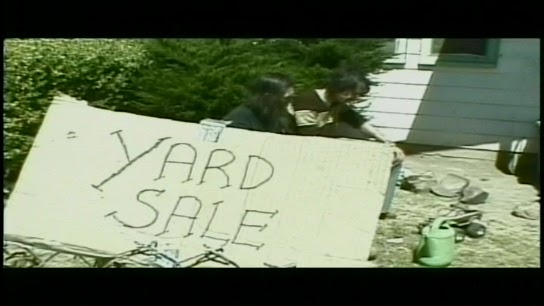
Wiggly is one of Andrews’s funniest films and also one of his most accessible.  The film plays out like the typical dysfunctional drama with the exception that the proceedings are played out in an only slightly exaggerated fashion.  In other words, Wiggly is closer to home than most would think.  The portrayal of Wiggly’s father by Vietnam Ron is so relatable:  he is so angry that he cannot get back into his camper that almost every phrase coming out of his mouth is “fuck this, fuck that, or fuck you.”  He cannot even sell the worthless crap at his garage sale, because he is too angry (to compound matters, his garage sale appears to be a Sisyphus-like exercise, leading to more headache).  In Wiggly’s only scene with his mother, the two go from having a polite conversation to his mother becoming violently overcome with new feelings and emerging with a demonic voice that threatens to kill Wiggly.  Bill Tyree gives my favorite performance as a senior citizen who attempts to seduce a volunteer Wiggly while playing a game of tic-tac-toe. 
The standout piece is Ants.  Andrews plays Ped (“It’s short for pedestrian”) the happy-go-lucky, rollerblading son of his documentarian father, again played by Vietnam Ron.  Ped’s father has been making a documentary on ants for the last twenty years and is in the final stages of completing his film.  He also appears to heading towards a mental breakdown as well.  As his father finishes his documentary, Ped encounters multiple people:  all the encounters are often enlightening and hilarious and are most often not random.
Ants is about outsiders, artists, and outsider artists.  The entire film is populated with outsiders and loners.  Ped’s grandfather is homeless (homeless people being the ultimate societal outsiders), and he and Ped have an amusing conversation about his grandfather “not securing his future.”  I thought money grew on trees, quips his grandfather, until he looked closer and noticed that they were leaves.  In the film’s best scene, Andrews films himself rollerblading alone in a parking lot while the audio plays over an original song by Andrews about rollerblading: it’s a pure film moment and shows Andrews’s adeptness at filmmaking.  The main focus of Ants, however, is Ped’s father and his obsession with his documentary about ants.  At one point in the film, Ped attempts to dissuade his father from completing the film: he’s worked on it too long and in the end, Ped argues, no one is going to care about watching a film about ants.  His father is not deterred: the satisfaction and the joy filming brings him are completely worth all of the trouble, the years spent filming it and the toll it took upon his psyche. 
The final piece is The Laundry Room and it is a light, humorous piece (incidentally, the closest to a horror film that I have seen from Andrews).  The center of the film is a long, dirty poem recited by Bill Tyree, playing a psychiatrist giving aid to a heartbroken MaryBeth that goes on for at least five minutes.  It’s the penultimate dirty limerick, and the rest of The Laundry Room is built around this scene.  The film stars Vietnam Ron, again, as a killer stalking a laundry room and looking for victims to take their shoes.  

After School Specials is one of my favorite films from Giuseppe Andrews.  I must have seen it at least twenty times and will inevitably see it more.  It is available as an extra on the Troma DVD of Touch Me in The Morning or directly from Andrews here.

Wednesday, July 1, 2015

Botas negras, látigo de cuero (Black Boots, Whip of Leather) (1983)

Botas negras, látigo de cuero (Black Boots, Whip of Leather) (1983) stars Lina Romay (under her screen name Candy Coster) and Antonio Mayans (under his screen name Robert Foster) as Al Pereira.  Jess Franco wrote and directed Botas negras and Juan Soler provided the photography.  It is a familiar tale:  detective Al Pereira gets entangled in a web of deceit, lured by a highly seductive woman.
Pereira is about to skip town as he owes quite a bit of money to a local gangster.  He stops packing to open the door whereupon gorgeous Lina enters.  She promises Pereira four thousand pesetas to go to the local scrapyard and retrieve her purse out of the trunk of a yellow Dodge car.  Lina tells him that no one will be there and she will wait for him while he competes the job.  The offer is too good to refuse, and Pereira accepts.  At the scrapyard, he finds the purse but is accosted by two armed men.  With a couple of karate moves and point-blank bullets, Pereira kills the two assailants.  Back at his apartment, now suspicious of the woman’s motives, Pereira questions her, but Lina maintains her innocence.  Overcome with emotion, the two fuck.  At the conclusion, Lina tells Pereira to come and see her at the cabaret, where she is a performer, called the Whip of Leather.  Pereira meets Lina at the club and they agree to have a secret rendezvous.  At a lakeside scene at sunrise, the two meet and fuck again.  Afterwards, Lina reveals to Pereira that her husband runs a gambling/prostitution/drug ring and shares his profits with a handful of partners.  If Pereira were to kill them all off, he and Lina could share in the profits alone.  Would he do it?  Pereira takes the bait.
Juan Soler’s photography is not particularly flashy: the compositions comprise mostly close-ups which actually works in the favor of Botas negras.  Franco’s screenplay for Botas negras, additionally, is not really strong, but again, like the photography, it works in the favor of the film.  The story truly focuses on the characters of Lina and Pereira; and for anyone who is a fan of Romay and Foster, each is truly at the peak of her/his ability.  “The Homecoming Films,” the films that Jess Franco made upon his return to Spain in the late seventies and early eighties, are not particularly valued by Franco’s critics or as well-seen by his fans, who, in general, prefer his sixties and seventies output.  I have always had a fondness for this period in Franco’s career:  there is such a diversity in his filmography, ranging from adult films to his haunting, poetic cinema, like Macumba Sexual (1981).  Botas negras would fall in the middle of that spectrum:  there is a heavy dose of sex within but the story leans more towards a mainstream, commercial appeal.  I also really enjoy Lina Romay in her “Candy Coster” guise (with her signature blonde wig):  now in her late twenties, Romay is a veteran actress; and in Botas negras is extremely sexy.  The crux of Botas negras relies upon her performance:  not only does Romay’s character have to seduce Foster’s Pereira but the audience.  At the lakeside, morning seduction scene, Lina seduces Foster by only opening her coat:  she needs little mystique in her eroticism.  Romay could have any man she wants.  Like Romay, Antonio Mayans (Foster) is a veteran actor and is one of the most handsome men with whom Franco has ever worked.  There is a cheap charm to his karate-chop action sequences, but Foster plays an obsessive Pereira to perfection.  This duo is, by far, one of the best with whom Franco had the ability to film.  The stripped-down qualities of both the photography and the screenplay allow them to shine. 

Botas negras, látigo de cuero is really for fans of Romay and Foster.  Especially Lina Romay.  The cheapness and predictable story will keep most away, but for the seasoned fan of Jess Franco, they are hardly a deterrent.

Monday, June 29, 2015

Edge of the Axe (Filo de hacha) (1988)

Edge of the Axe (Filo de hacha) (1988) can be seen as José Ramón Larraz’s companion piece to Rest in Pieces (Descanse en piezas) (1987), both American-style horror flicks, shot under his pseudonym “Joseph Braunstein.”  My expectations towards Edge of the Axe were seeing an interesting film directed by Larraz, tempered by the fact that Rest in Pieces was mostly average.  To its credit, the script of Edge is focused (by Pablo de Aldebarán), but its focus does not save the film from its overly-talky scenes, its mechanical nature, and lack of energy driving it.
Edge of Axe opens at the car wash.  A woman enters the automated car washing machine and as the suds of soap cover her car, she sees out of the periphery of her eye, a figure donning a hooded raincoat and wearing a white mask which is absent of any features.  This figure kills her.  Enter Gerald Martin (Barton Faulks), a young man with a penchant for fixing appliances and a deep love for personal home computers.  He lives in small rural cabin which he rents from an old man in an adjacent home.  His homey is Richard Simmons (Page Mosely), the small-town exterminator, and Gerald accompanies Richard on jobs for a little extra income.  Weird shit has been happening all over town:  a local couple, who raise their own livestock, become scared when an intruder raids their farm under the cover of darkness; decapitates a pig; and places it on the pillow of the farm’s young wife.  Gerald and Richard are heading to a local bar and grill to investigate a nasty smell which the barkeep says is coming from his cellar.  In a crawlspace in the ceiling of the cellar, Richard opens and finds the corpse of young barmaid, Maria.  The town sheriff is too cool for school:  he thinks the pig head is a prank and not worth investigating and would prefer for the medical examiner to label Maria’s death as a suicide.  He does not want to scare anyone in the town.  Although Richard is married to a very beautiful and wealthy woman named Laura (Patty Shepard), he thinks that she is too old.  Richard and Gerald arrive at another location to pick up Laura and while waiting, they meet sexy sisters, Susan (Joy Blackburn) and Lillian (Christina Marie Lane) Nebbs.   Richard takes a liking to Susan, and vice versa; while Gerald immediately captures the heart of young Lillian.  Gerald gives her a second-hand computer terminal, so the two can chat at a distance.  When Rita (Alicia Moro), the local hairdresser who moonlights as a call girl, agrees to meet a john at the local train yard, she is butchered by the hooded figure donning the lifeless white mask with a sharp axe.  The sheriff wants to rule this one an accident, too, but common sense is dictating the presence in the small town of a killer…
Gerald and Lillian become the focus of Edge of the Axe, and as they grow closer together, each reveals to the other some dark secrets in his/her past.  Meanwhile, life in the small town goes on as usual: the local church choir is still preparing for a performance (of whom Lillian is a member); the locals gather at the bar for drink and conversation; and the sheriff pursues whatever leads that he has at hand towards finding the killer whose body count is racking up.  There is a notable absence of dread in Edge of the Axe, the feeling that a town is in the grips of a brutal killer.  I have praised before Larraz’s ability to create unique visuals and, especially, atmosphere.  Those qualities are absent here.  It appears that Larraz is going to let the screenplay for Edge to do the talking for him:  hints towards the motive and identity of the mysterious killer are all given in characters’ dialogue.  There are, unfortunately, too many of these scenes, and they slow down the energy of the action.  The kill scenes do have a panache about them (they are competently done); but if you have seen a lot of slasher films from the 1980s (as I have), then the scenes seem unoriginal and tired.  The screenplay of Edge of the Axe is preparing its viewer for its surprise reveal ending.  The seventy five minutes preceding it, however, are not compelling enough to capture my total attention.
I would rank Edge of the Axe at third from the trio of American-style horror flicks that Larraz made at the end of the 1980s.  Deadly Manor (1990) has more weird shit and atmospheric visuals than Rest in Pieces and is the best of this trio.  However, even Deadly Manor has awful, detracting dialogue which really devalues the whole film.  I will reserve further discussion of Deadly Manor for another day.  A hungry fan of American slashers, especially those from the 1980s, would probably enjoy, at least for a single viewing, Edge of the Axe.  For fans of José Ramón Larraz, like me, we would be better served looking at his work from the seventies.